Client
A digital health company developing AI-powered gait analysis for early detection of mobility, neurological, and age-related health conditions.
The client wanted to move beyond expensive, lab-heavy motion-capture systems and build a more practical, camera-based solution suited to real-world adoption in clinical and care settings. The target system performs video-based gait characterization using a single fixed iPad camera, producing 3D keypoints, joint angles, body-segment rotations, gait events, and spatiotemporal gait parameters.
Problem Statement
When the client engaged MulticoreWare, they had no full stack AI inference pipeline capable of predicting clinically relevant human-motion kinematics from a monocular camera setup.
The challenge was demanding because the goal was not 2D pose estimation for consumer wellness or fitness. The solution needed clinical-grade accuracy to support pathology-related gait interpretation, while using a far simpler and more patient-friendly setup than a conventional motion-analysis lab.
Traditional gait-analysis systems are costly and setup-intensive, making them hard to scale and impractical for patient populations such as individuals with cognitive decline or mobility limitations.
Technical Challenges
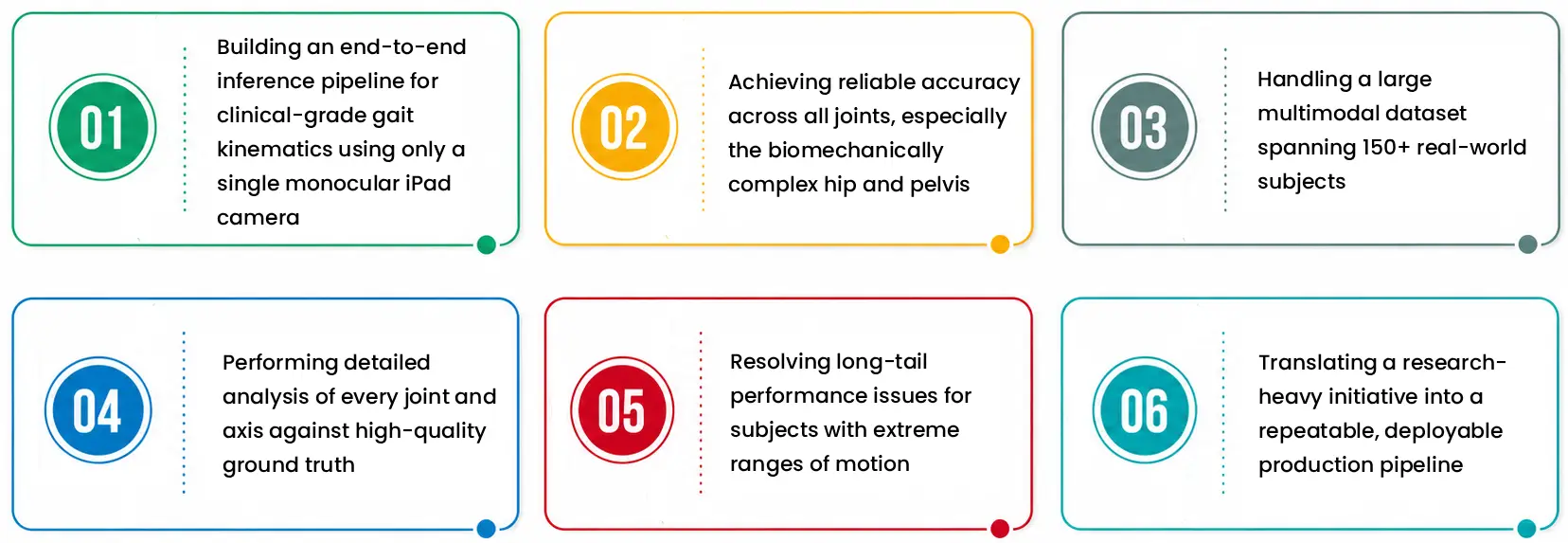
Solution Overview
MulticoreWare engineered a comprehensive AI and analytics pipeline that delivers clinically meaningful gait analysis from a single monocular camera. The solution comprised:
- Multi-stage, vision-based human-motion analysis
- Learning-based 3D pose and kinematic estimation
- Gait-phase and event-detection models
- Biomechanics-driven motion-interpretation algorithms
- An end-to-end data-processing and analytics pipeline
- Cloud deployment with CI/CD integration
Implementation
Statistical performance analysis
MulticoreWare applied advanced data-science and validation methods to assess agreement, error distribution, and reliability, including Bland-Altman plots, violin plots, box plots, t-tests, Wilcoxon tests, and the Pearson correlation coefficient.
Ground-truth-driven development
To meet clinical-grade performance goals, the solution was developed and validated against a rich multimodal dataset captured with 3D marker information, pressure plates, and multi-camera systems. This enabled detailed benchmarking against high-quality ground truth across joints, axes, and gait events.
Research and problem framing
MulticoreWare began by tackling the core research question: how to estimate clinically useful gait kinematics from a monocular camera, in a field still relatively immature for clinical use.
Productization and iterative improvement
Over the engagement, the team delivered 10 major software releases while supporting deployment, integration, and continuous enhancement of the client’s platform.
Model-pipeline engineering
The team engineered a modular, multi-stage inference pipeline to convert monocular video into clinically relevant gait insights, focusing not only on individual components but on:
- End-to-end accuracy and stability across stages
- Improving challenging joint estimations (hip and pelvis)
- Embedding biomechanical constraints
- Supporting real-world deployment at scale
Business Impact
- Reduced the cost and complexity of gait assessment by replacing lab-based motion capture with a single iPad camera
- Expanded access to clinical-grade motion analysis across more care settings
- Improved patient adoption through a simpler, more comfortable setup
- Enabled scalable deployment across healthcare environments via cloud and CI/CD
- Supported data-driven gait-pathology evaluation validated against high-quality ground truth
- Strengthened the client’s commercialization roadmap with a production-ready pipeline
Conclusion
This engagement demonstrates MulticoreWare’s ability to solve high-complexity AI problems at the intersection of computer vision, biomechanics, clinical analytics, and production deployment.
By engineering a full monocular gait-analysis pipeline from the ground up, MulticoreWare proved that clinically meaningful motion kinematics can be derived from a far more accessible camera setup than traditional lab systems, creating a scalable foundation for advanced digital-health applications where precision, practicality, and deployment readiness all matter.