Client
The client is a global leader in network management software, delivering end-to-end network and service management solutions for enterprise, telecom, industrial, and data centre networks. Their platform manages a vast and diverse range of devices across enterprise, cloud, edge, and hybrid environments providing large-scale configuration, monitoring, and remediation capabilities.
Problem Statement
As networks grow increasingly distributed and dynamic, the client’s existing policy management system faced challenges adapting to real-time network changes. With a wide variety of devices, fluctuating traffic patterns, diverse users, and evolving security requirements, their static policy rules and manual enforcement mechanisms proved time-consuming and prone to errors. The static nature of policy definitions made it difficult to handle performance fluctuations, link state variations, and security threats effectively.
These limitations led to misconfiguration risks, delayed responses, redundant policies, and overall inefficiencies in policy consistency across multi-vendor environments. The client sought a next-generation solution that could minimize manual intervention, enhance adaptability, and ensure consistent, real-time policy management based on live network telemetry creating a foundation for intelligent, auto-healing, and self-sufficient network operations.
Solution
MulticoreWare collaborated with the client’s architecture and design teams to evolve their existing platform into a smart, adaptive, and auto-healing solution powered by AI. Leveraging our deep expertise in artificial intelligence and systems optimization, we proposed an AI-Driven Policy Management Solution an intelligent and dynamic layer that continuously interprets real-time network conditions and autonomously generates, validates, and deploys network policies to enhance performance, reliability, and security.
The solution integrates comprehensive telemetry data metrics, logs, and event-driven traps to assess the live network state, understand existing policies, and identify configuration gaps.

Using AI agents, the system learns network behaviour, validates policy sufficiency, regenerates or adapts policies as needed, and deploys them seamlessly across multiple devices. The adaptive policies span ACLs, IDS/IPS, QoS/QoE, Access Control, Authorization, Rate Limiting, and Forwarding Rules, enabling end-to-end, intelligent policy enforcement across complex and heterogeneous networks.
Core elements
- Context-Aware Policy Generation:
Utilizes LLM-based models to interpret device roles, network states, and intent definitions, generating or refining policies dynamically. - Telemetry-Driven Adaptation & Feedback Loop:
Continuously integrates with the client’s monitoring agents to analyse health metrics and threat intelligence, refining policies in real time based on live insights. - Model Context Protocol (MCP):
Integration Ensures secure interaction between AI agents, network APIs, and controllers (e.g., Meraki, OpenStack, and custom fabric orchestrators). - Validation and Rollback Framework:
Each generated policy undergoes automated validation and benchmarking before deployment, with rollback mechanisms to maintain network stability. - Continuous Learning Engine :
The AI agent improves through ongoing observation and feedback, learning from successful and failed policy deployments to optimize future responses.
Technology Stack
| Layer | Tools & Frameworks |
|---|---|
|
AI / Automation |
Llama model, LangChain, MCP |
|
Network Integration |
OpenStack, RESTful Controller APIs |
|
Performance Metric |
~97 tokens/sec on local cluster |
Success story
A 30-minute live benchmark compared manual management with an autonomous AI agent during sustained load and an injected container failure. The human-managed system showed slow detection, long remediation delays, and instability under stress. It processed 5,420 requests with a 78.04% success rate, high tail latency (p99: 890.2 ms), and required three manual interventions. Recovery took 147.5 seconds, leading to 158 seconds of downtime and 91.23% availability.
In contrast, the agentic AI system autonomously detected the failure, provisioned a new container, updated HAProxy policies, and restored capacity without human input. It processed 5,890 requests with a 98.51% success rate, maintained low latency (p99: 145.8 ms), and achieved full recovery in 12.3 seconds. Downtime dropped to 4.1 seconds, and availability reached 99.77%. The results show a dramatic gain in resilience, responsiveness, and service quality through automated policy generation and self-healing behaviour.
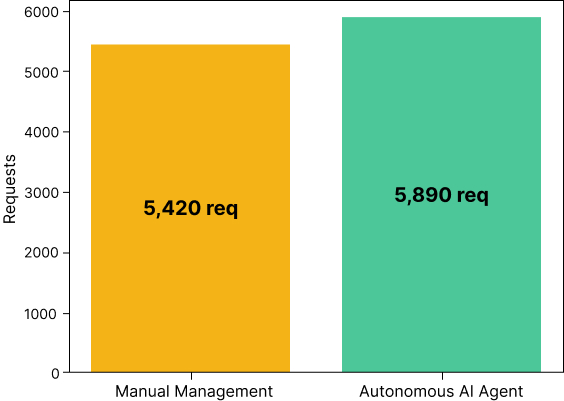
Figure 1 - Total Requests Processed
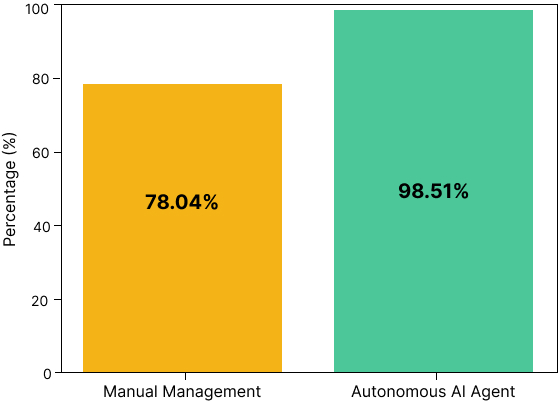
Figure 2 - Request Success Rate
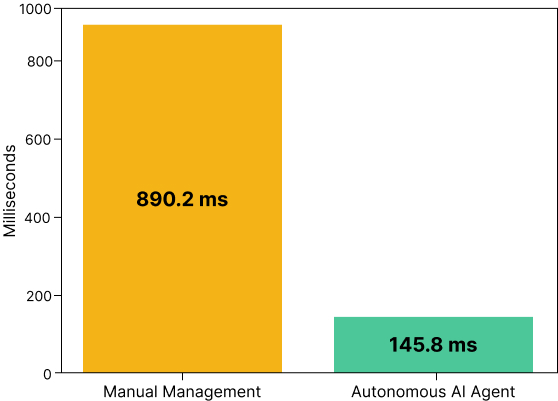
Figure 3 - p99 Latency
(Lower values indicate better performance)
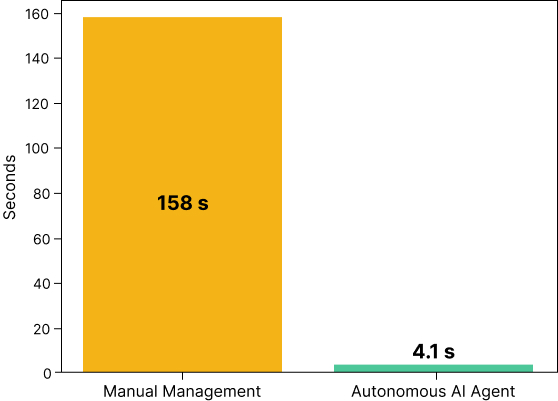
Figure 4 - Total Downtime
(Lower values indicate better performance)
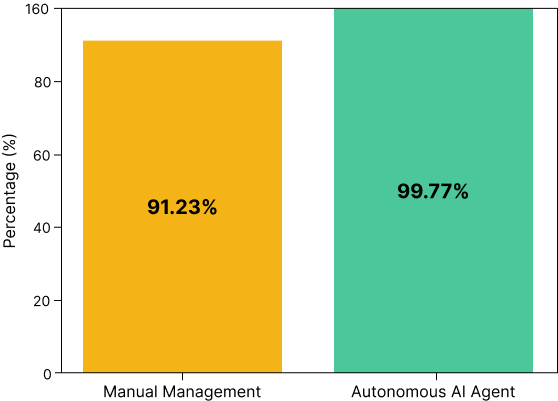
Figure 5 - Service Availability
| Metric | Manual system | Auto-healing NW Agent |
|---|---|---|
|
Requests Processed |
5,420 |
5,890 |
|
Success Rate |
OpenStack, RESTful Controller APIs |
98.51% |
|
Avg Latency |
185.3 ms |
42.7 ms |
|
p99 Latency |
890.2 ms |
145.8 ms |
|
Recovery Time |
147.5 s |
12.3 s |
|
Total Downtime |
158 s |
4.1 s |
|
Availability |
91.23% |
99.77% |
|
Manual Interventions |
3 |
0 |
MulticoreWare’s Value Proposition
- Observability-Driven Optimization
Linked telemetry feedback to AI reasoning for adaptive network fine-tuning. - Mapping of AI and Network Translation
Layer Maps AI-generated intents to network configurations and interprets operational data like SNMP traps or OAM events back into AI-readable context. - Orchestration Pipeline Modernization
Refactored the client’s static workflow into an event-driven architecture, enabling on-demand policy updates based on network state changes. - Integrated Validation Framework
Runs automated regression and stress tests in virtualized network environments to validate performance and reliability at scale. - Collaborative Development Model
Joint teams across multiple workstations ensured smooth integration with existing systems and continuous technical support
Core Value Proposition
The solution streamlines network operations by enabling administrators; even those without deep scripting expertise, to automatically generate optimized policies. Its AI-driven, self-healing design continuously observes network conditions and adjusts policies in real time, ensuring performance remains aligned with operational goals. This intelligence also shortens mean time to resolution (MTTR) by accelerating issue detection and automated remediation.
Operator workflows are further enhanced through assisted policy generation and fine-tuning, allowing teams to move faster without sacrificing oversight or control. Built for enterprise scale, the system operates securely across large, heterogeneous, multi-vendor environments, ensuring seamless compatibility and robust policy management end to end.
Conclusion
By deploying an AI-driven, adaptive policy management solution, the client has transformed their traditional network management system into a smart, agile, and self-healing platform that delivers intelligent policy control across enterprise, telecom, industrial, and cloud environments. This innovation not only enhances scalability, security, and operational agility but also sets a new benchmark for intelligent and autonomous network management in the industry.
MulticoreWare’s expertise in AI solutions, observability-driven optimization, and intelligent network automation enabled this transformative advancement. To learn how we can help your organization leverage AI for innovation and impact, please contact info@multicorewareinc.com.